3JSBench
Why this matters
Building a useful 3D environment requires objects whose structure matches the intended design. A rendered image provides one view of that structure; inspecting the object from several angles reveals more.
3JSBench Leaderboard
| Model | Pass rate | Passes |
|---|---|---|
| Astra | 71.0% ± 5.1 | 213 / 300 |
| Fable | 66.3% ± 5.3 | 199 / 300 |
| Claude Opus 5.5 | 44.0% ± 5.6 | 132 / 300 |
| GPT-6 Sol | 23.7% ± 4.8 | 71 / 300 |
| Kimi K3 | 22.3% ± 4.7 | 67 / 300 |
| Grok 4.7 | 18.7% ± 4.4 | 56 / 300 |
| Grok 4.6 | 12.0% ± 3.7 | 36 / 300 |
| Muse Spark 1.3 | 7.0% ± 2.9 | 21 / 300 |
| Gemini 3.8 Flash | 6.7% ± 2.8 | 20 / 300 |
| Inkling | 1.7% ± 1.4 | 5 / 300 |
Pass-rate snapshot: October 5, 2026 (UTC).
Same task, different results
Drag to rotate · Right-drag to pan · Scroll to zoom
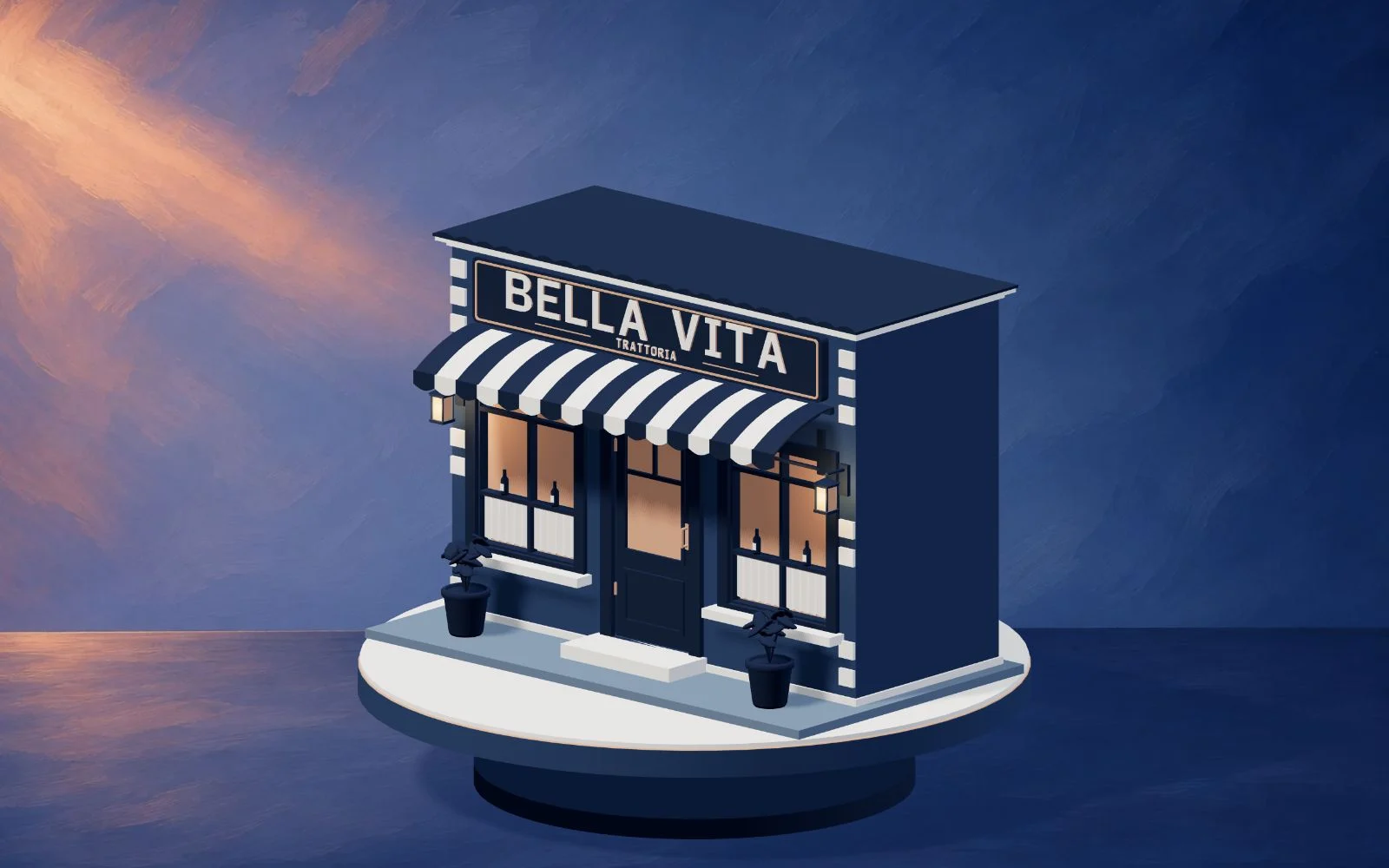
“A cozy Italian restaurant storefront with the restaurant’s name on the sign above the door, warm lit letters over a striped awning.”
ChecksCollapseAwning slopes downward PassAwning is one piece PassDraw-order stability Pass
| Check | Observed | Result |
|---|---|---|
| Runs without errors | ||
| Valid geometry | ||
| Surfaces face outward | ||
| No detached parts | ||
| Readable restaurant name | “BELLA VITA” | |
| −19.1° | ||
ChecksCollapseAwning slopes downward FailAwning is one piece FailDraw-order stability Fail
| Check | Observed | Result |
|---|---|---|
| Runs without errors | ||
| Valid geometry | ||
| Surfaces face outward | ||
| No detached parts | ||
| Readable restaurant name | “TAVTTORIV” | |
| +24.1° | ||
| 5 pieces |
Two actual benchmark outputs. Each viewer runs the model’s original Three.js program with the grader’s scene: the same three.js release, lights, color output, and camera framing, shown on white. Zoom in on the glass in Grok’s door and orbit: the panes sit in the same plane as the door, so they flicker as the two surfaces fight for the same depth.
Common failure modes
At a glance, both storefronts look plausible: each has a facade, a lit sign, a striped awning, windows, and a door. Inspection tells them apart. Astra’s sign reads “BELLA VITA,” and its awning is a single piece that slopes down and away from the wall. Grok’s sign reads “TAVTTORIV,” its awning rises 24° away from the wall in five disconnected pieces, and the glass in its door flickers because it shares a plane with the door, so whichever surface is drawn last wins.
The checks beneath each viewer come from its saved evaluation report.
Methodology in brief
- Generate an object from a brief. Each task specifies a 3D asset in natural language. The model produces a Three.js program that builds the object.
- Evaluate the scene. The evaluator runs the program and checks geometry, rendering, and task-specific structure in the native Three.js scene. The storefront task checks that the sign and awning are mounted on the facade, the awning is one piece that slopes downward, and the sign carries a readable restaurant name.
- Count passing attempts. An attempt passes only when every required check passes. The leaderboard reports passing attempts divided by total attempts; withheld outcomes are not counted as passes.
Scope and reproducibility
The benchmark measures generated objects against explicit checks. A pass does not establish artistic quality, physical realism, or suitability for a larger application. Checks have applicability conditions, and an unavailable measurement is distinct from a failure.
Each example includes its generated source and a report with source hashes, the evaluator revision, and saved check outcomes. These are saved evaluations, not new runs performed by this page.